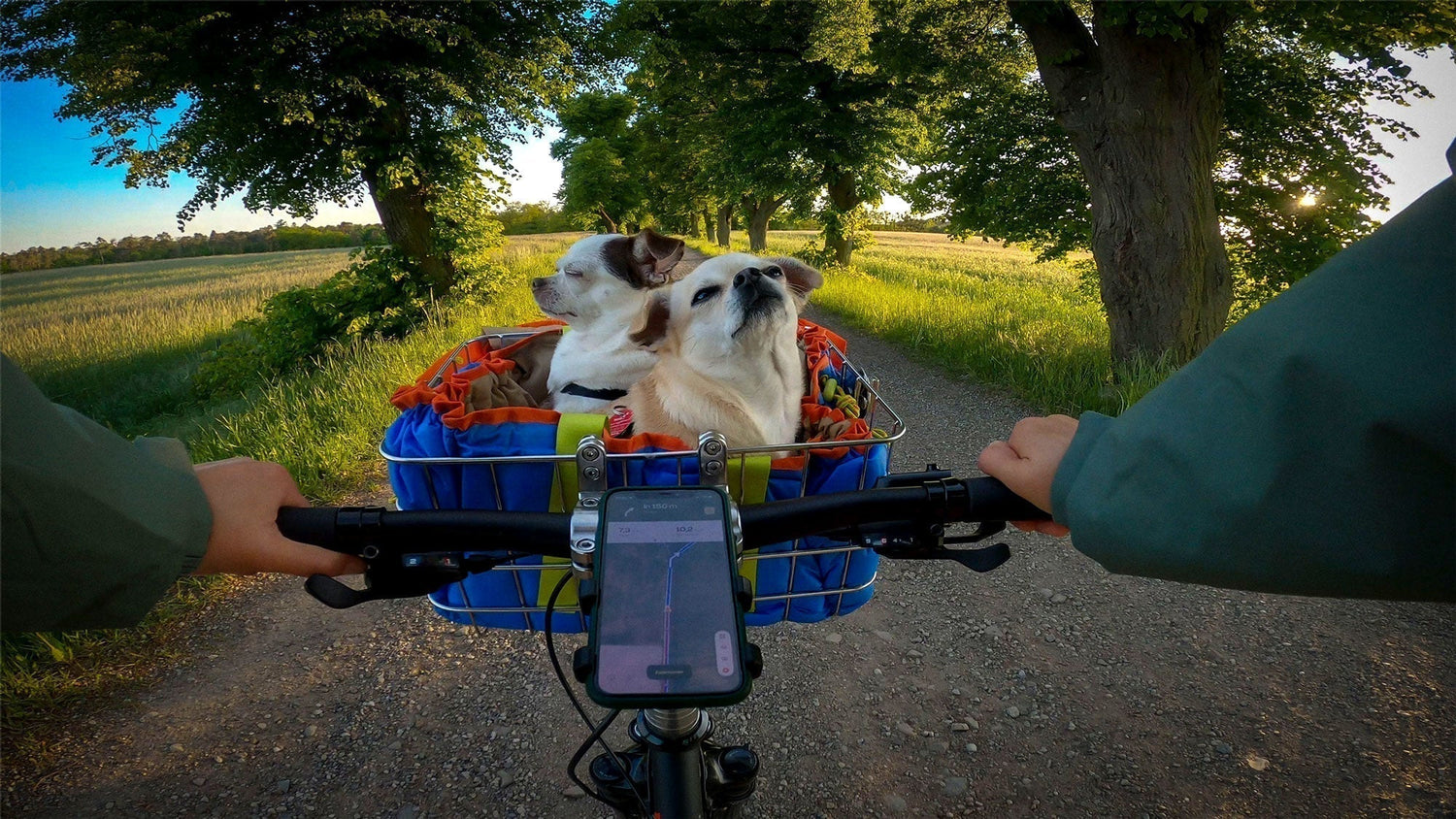
Cycling means freedom.
For many dog owners, taking their dog along is simply part of it – to the lake, into the city, to the campsite, or on long bike tours.
But before the first kilometre together begins, one crucial question arises:
How do you get a dog used to a dog bike basket?
Many people expect a simple guide with just a few steps.
In reality, however, it is about something entirely different.
A dog does not need to learn how to sit in a bike basket.
They need to learn how to feel safe in it.
That is exactly what makes the difference between a dog that watches every movement attentively, constantly stands up, or tries to leave the basket – and a dog that lies down calmly and enjoys the ride.
Getting a dog used to a dog bike basket is therefore not a race.
It is a learning process in which trust develops step by step.
In this article, we guide you through this process – from the first few minutes on the floor to the first relaxed bike ride.

The Most Important Points at a Glance
Getting a dog used to a dog bike basket does not begin with the bicycle, but at home.
Before movement is introduced, your dog should learn to see the basket as a safe and familiar place.
Calmness, patience, and small training steps are far more important than rapid progress.
Only once your dog can lie calmly in the basket should training with movement and later with the bicycle begin.
Why a Dog Bike Basket Is Something Completely New for Your Dog at First
From our perspective, a dog bike basket is a practical means of transport.
For your dog, it is initially something entirely different.
They encounter an object they have never experienced before.
A new smell.
A new surface.
An unfamiliar height.
Later, further impressions are added:
- new movements
- slight vibrations
- unfamiliar speeds
- changes of direction
- small jolts
- new sounds
- many external stimuli
While we can naturally interpret all these impressions, your dog first has to become familiar with them.
That is why some dogs initially react with curiosity, others with caution, and some with clear uncertainty.
None of these reactions is unusual.
They simply show that your dog is trying to understand the new situation.
That is exactly why training should never begin with the first bike ride.
It begins the moment your dog sees the basket for the first time.

Background Knowledge
Dogs do not learn situations in fixed stages.
They associate experiences with emotions.
If a situation feels safe, trust develops.
If it feels uncontrollable or overwhelming, that feeling also remains in their memory.
That is why the decisive factor during training is not how quickly you progress.
What matters is the experience your dog has during every individual training step.
The Most Important Training Rule: Calmness Beats Speed
Many dog owners understandably look forward to their first bike ride together.
However, this excitement often causes the next training step to happen too soon.
The dog sits calmly in the basket for the first time – so the bike ride begins immediately.
The first ride goes well – so the next, slightly longer route follows straight away.
This often leads to unnoticed overwhelm.
Not because the dog is doing anything wrong.
But because they have not yet had the opportunity to build trust.
Based on our experience, a simple training philosophy has proven effective:
The 70/30 Rule
70 percent calmness, patience, and understanding.
30 percent calm, controlled enthusiasm.
This does not mean that training has to be slow.
It means that you should project calmness yourself.
Your dog takes their cues from your emotional state.
Nervousness, uncertainty, or haste are transferred just as easily as excessive excitement.
Of course, you are allowed to be pleased.
Praise is important.
It strengthens trust and motivation.
What matters, however, is the way you praise your dog.
The dog bike basket should not become a place of extreme emotion.
Not a place of fear.
But also not a place where your dog becomes completely overexcited.
It should become a place where calmness feels entirely natural.
Patience is equally important.
Some dogs understand what is expected after only a few training sessions.
Others need considerably more time.
Both are completely normal.
Small setbacks are also part of the learning process.
If your dog takes a step backwards today, that does not mean the training has failed.
Sometimes it simply means that you should repeat this step together once more.
The fastest dog does not necessarily learn best.
The dog who is given the opportunity to build trust at every stage does.
Training Begins on the Insert – Not in the Basket
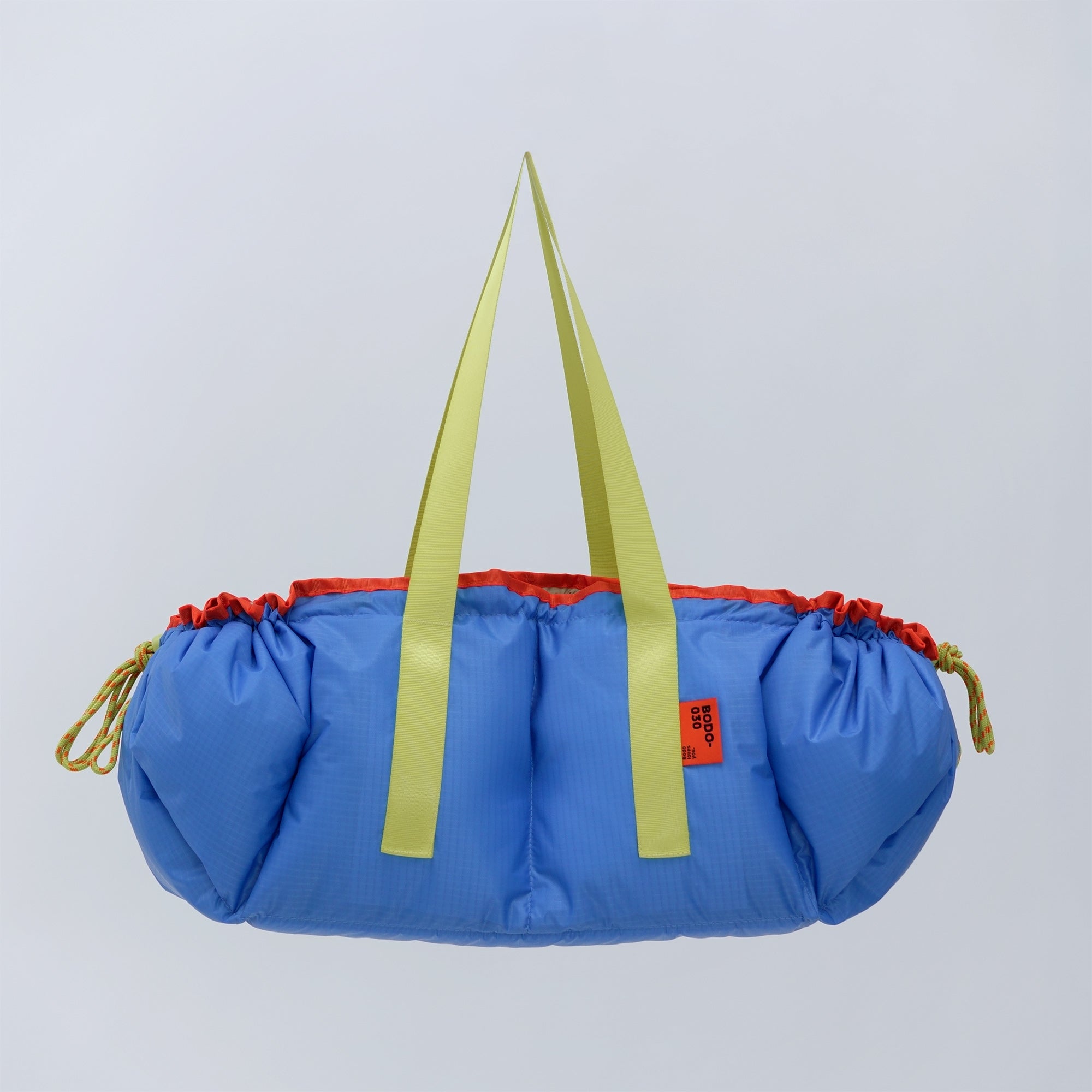
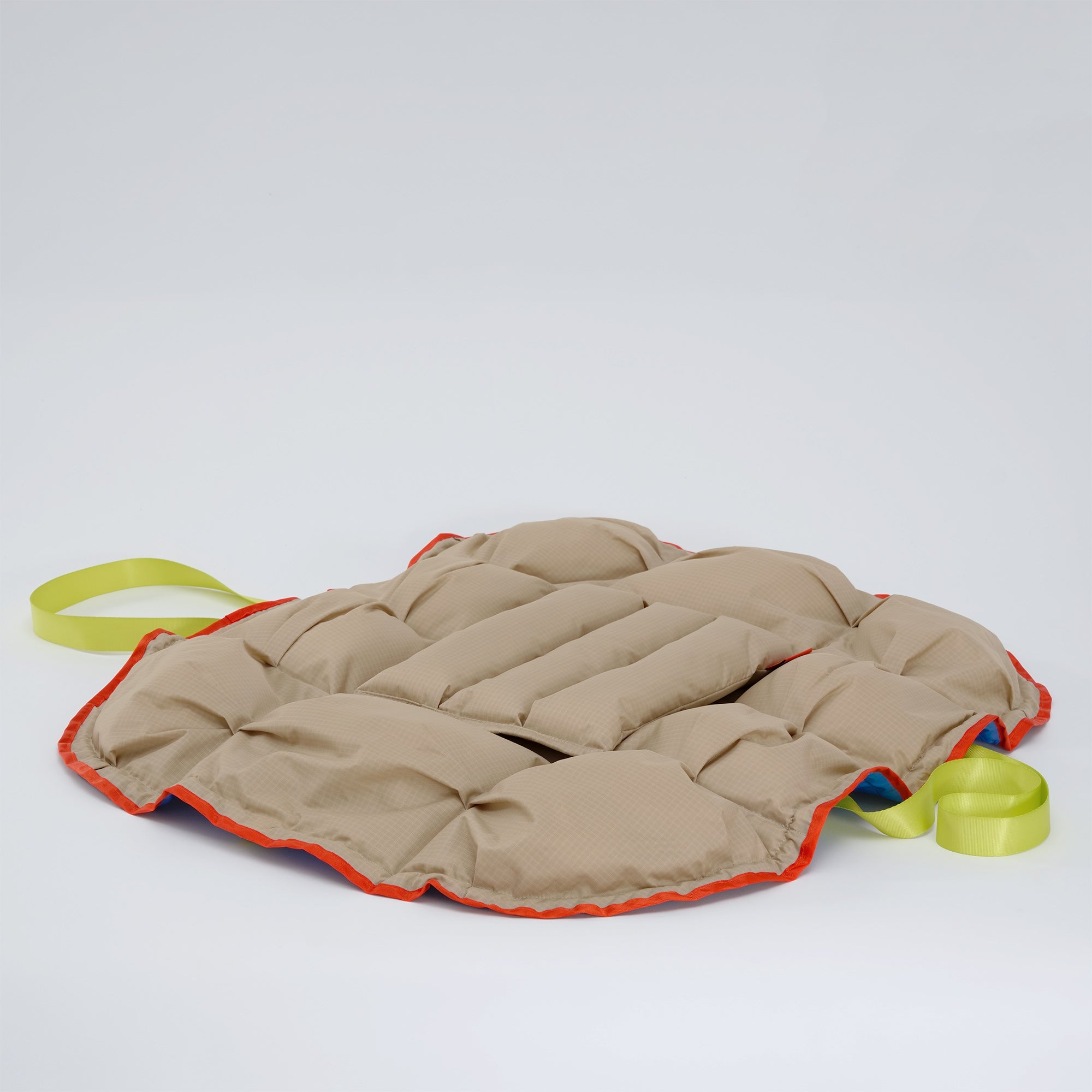
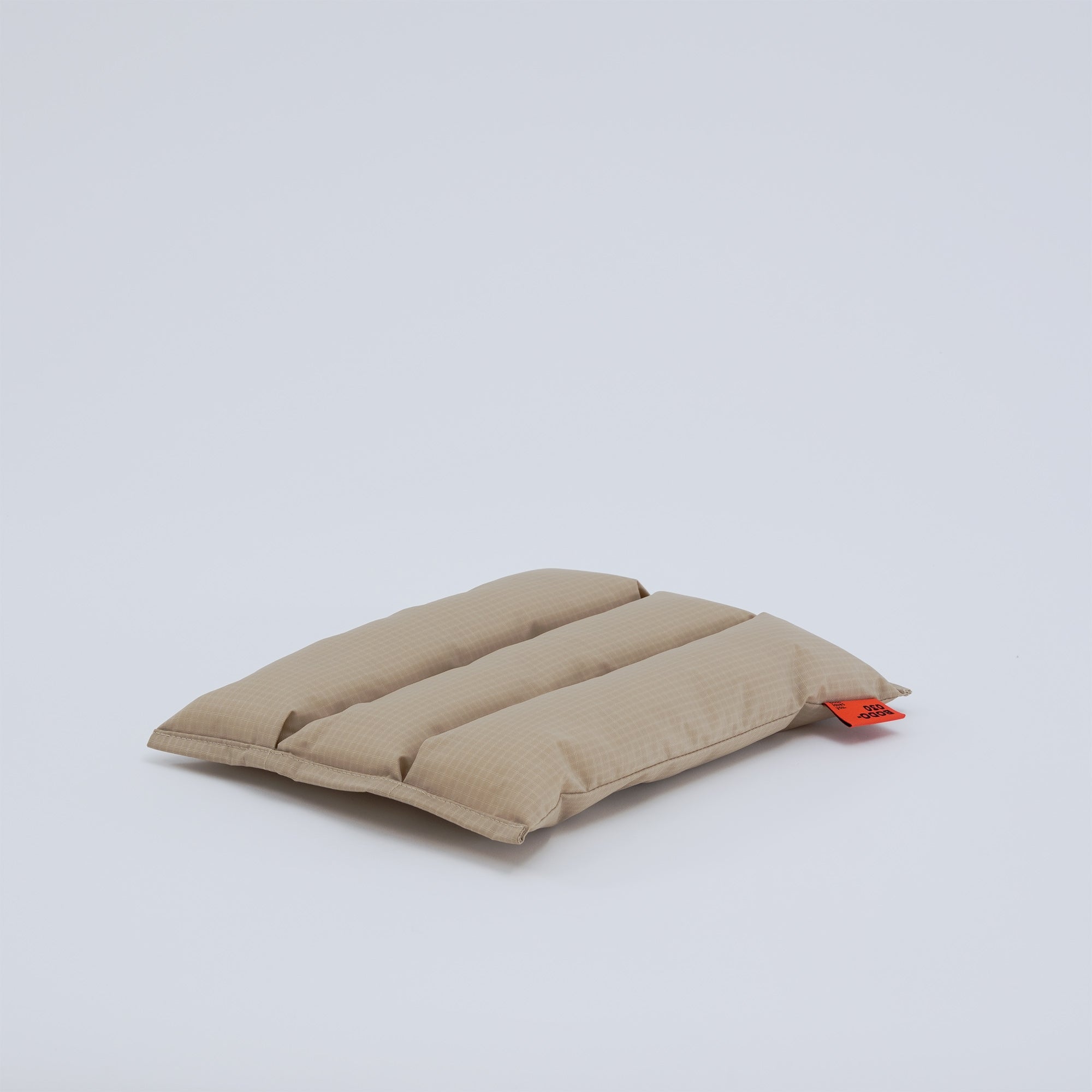
Before your dog becomes familiar with the dog bike basket, the process begins on the padded insert, cushion, or a familiar blanket.
First place it on the floor and calmly guide your dog to their spot.
There, they should learn to remain lying down and settle until you end the exercise.
This is not only about your dog enjoying lying on the insert.
They should also understand that they do not leave the spot independently as soon as something else becomes more interesting or they no longer feel like staying there.
You determine when the resting phase begins and when it ends.
The long-term goal is a dog that remains lying in their spot even when something is happening around them or they would prefer to stand up at that moment.
This does not mean restraining them or correcting them harshly.
It means remaining calm, patient, and consistent.
Begin by practising:
- lying calmly on the insert
- remaining in the designated position
- tolerating external stimuli
- only standing up after your release signal
Only once your dog has understood that this place is associated with calmness and reliability does the insert move into the dog bike basket.
What Your Dog Learns
The resting place is not an optional invitation that they may end whenever they choose.
They learn:
This foundation becomes particularly important later in the dog bike basket.

During the ride, your dog must not suddenly stand up, jump out, or independently decide to leave the basket.
The Resting Place Now Moves into the Dog Bike Basket
Continue to place the dog bike basket securely on the floor and put the familiar insert inside.
Now lift your dog into the basket calmly and in a controlled manner.
No rushing.
No forceful pushing.
No unnecessary excitement.
Your dog is lifted in calmly and later lifted out just as calmly.
It is important that they neither jump into the basket independently nor jump out by themselves.
You decide when the exercise begins and when it ends.
This creates clear routines and prevents your dog from later deciding independently when to leave the basket during training or while riding.
Inside the basket, the initial task remains the same as before on the insert:
Remain lying calmly.
Do not constantly stand up.
Do not climb over the edge.
Do not jump out independently.
At the beginning, the duration should be adapted individually to your dog’s personality and current level of training.
Some dogs may initially manage only 30 seconds.
Even this brief resting phase is already a success and should be rewarded.
Other dogs find lying down easy and can remain relaxed for considerably longer from the beginning.
Particularly high-value treats may be used throughout the entire learning process.
They help create a positive association with the resting place and show your dog which behaviour is desired.
Reward especially those moments when your dog lies calmly, visibly relaxes, or remains in their spot despite an external stimulus.
The reward should be given calmly so that it does not create new excitement.
Increase the duration gradually and always in a way that your dog can still manage the task.
If restlessness appears, the training step may have been too long or too demanding.
The next session should then be made slightly shorter or easier again.
The final stage of this familiarisation phase is reached when your dog remains lying calmly in the basket for a longer period until you lift them out – even if they would prefer to stand up, observe something, or leave the spot.
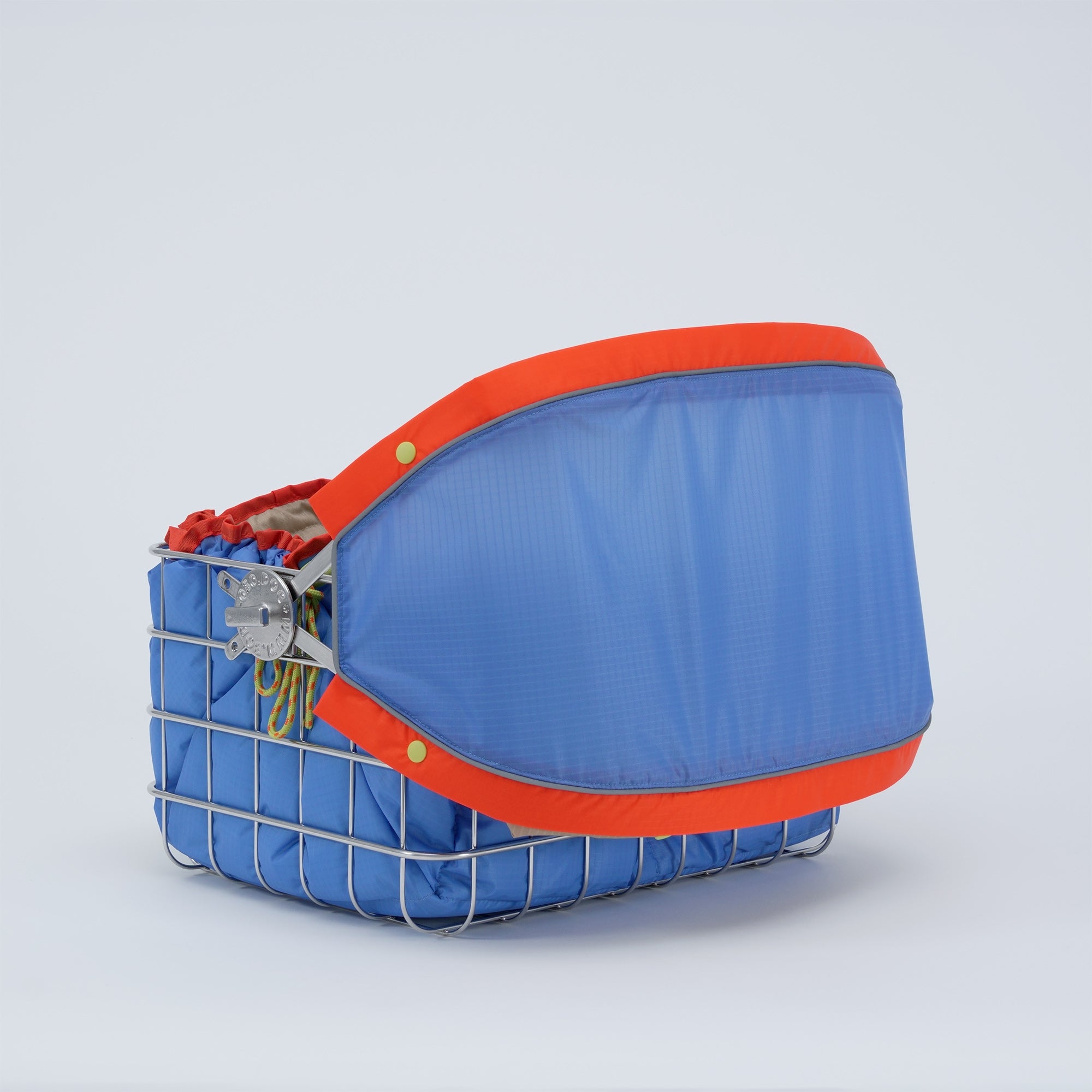
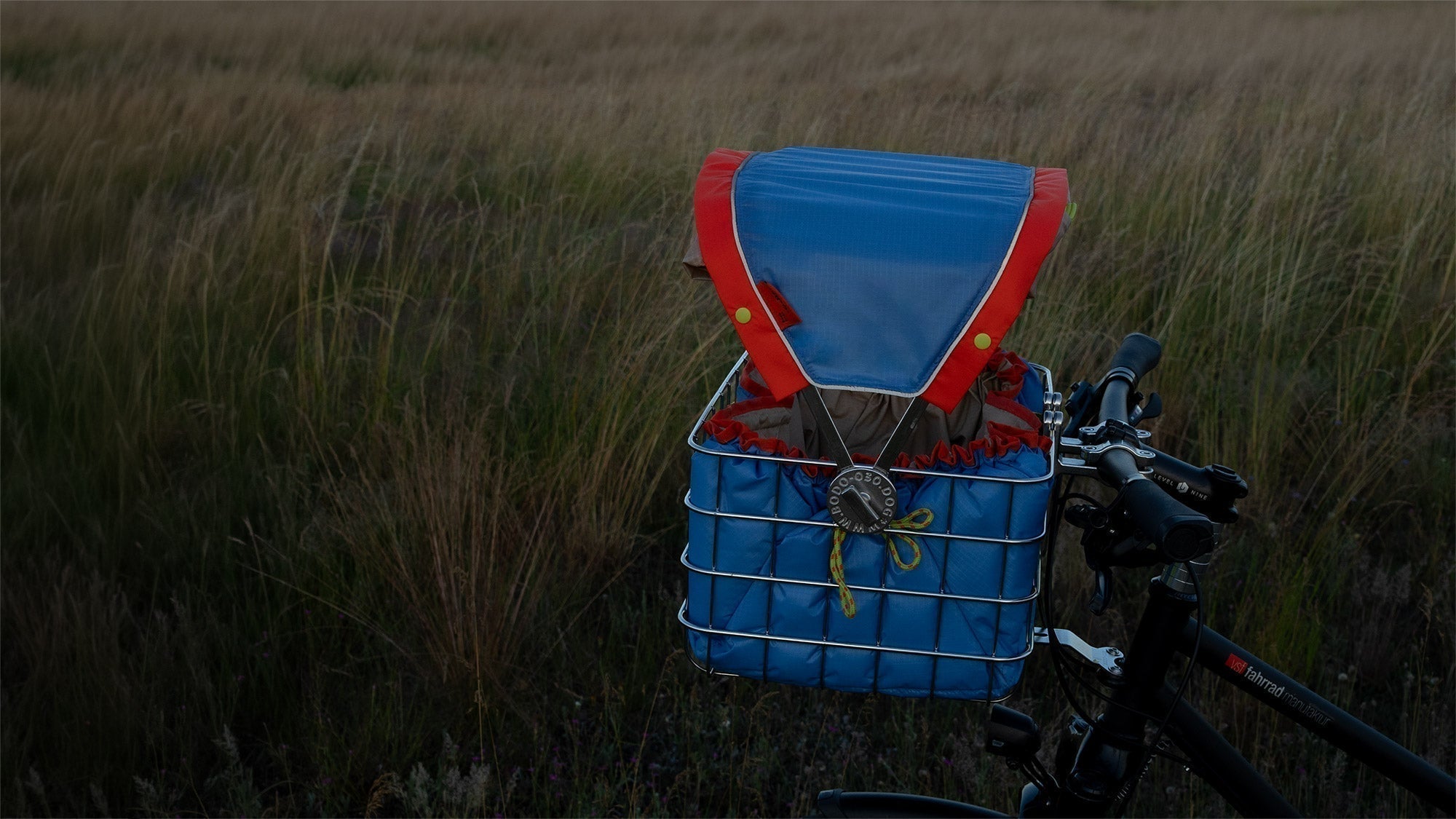
The Canopy Is Also Part of the Familiarisation Process
It is not only the movement of the dog bike basket that is new for your dog.
Opening, closing, and adjusting the canopy also changes their immediate surroundings.
This creates new impressions:
- sounds from fabric, fasteners, and moving elements
- shadows and changing light conditions
- a partially or fully protected environment
- a changed field of vision
- movements close to their head
That is why your dog should become familiar with the canopy in a calm environment – not during the first bike ride.
Begin with the canopy open and initially move individual elements slowly.
Your dog remains lying calmly in the basket.
Then open and close the canopy step by step.
Change only one thing at a time and give your dog time to process the sound and the new position.
Reward them calmly when they remain lying down and accept the change without concern.

What Your Dog Learns
The canopy can move, make sounds, and change their surroundings without presenting a danger.
They learn:
Familiarisation with the protected or largely closed position is particularly important.
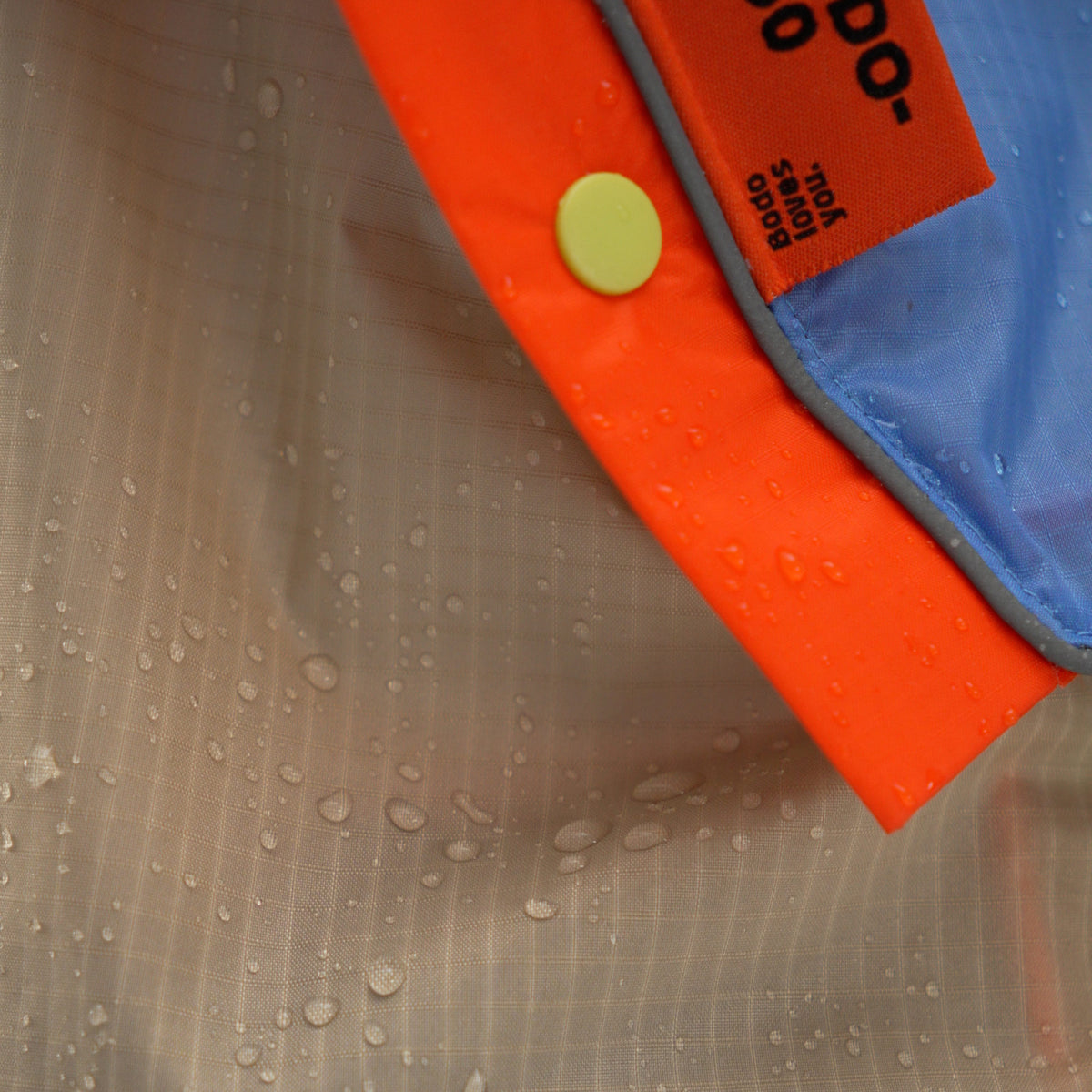
Your dog should not experience this position for the first time during sudden rain, strong wind, or intense sunshine.
In such a situation, many external stimuli are already present at the same time.
If your dog has previously experienced the closed position in a calm setting, they can interpret it much more easily later.
It Is Not Only the Dog Who Has to Learn the Routine
The familiarisation phase is also practice for you.
Use the calm training situation to familiarise yourself with how the canopy is handled:
- How is it opened and closed?
- How are the individual positions adjusted?
- How can the protection be adapted to sun, wind, or rain?
- Which movements must be carried out and in what order?
- How can you avoid hectic or jerky movements?
The more confidently you master the routine, the more calmly you can act later.
This is particularly important when the weather changes while you are out.
You should not have to work out how the canopy is adjusted only when that happens.
Stop and secure the bicycle safely before making any changes to the canopy.
The canopy must not be operated while riding.
This way, your dog not only becomes familiar with the canopy.
At the same time, a clear and calm routine develops that both of you can rely on.
Movement Begins Only Once Calmness Is Established
Movement is introduced only once your dog can remain lying calmly on the insert and afterwards in the dog bike basket.
As long as your dog still constantly stands up, looks over the edge, tries to climb out, or can only be kept in the basket through constant distraction, the next step is still too early.
Your dog should have understood:
When I am lifted into the basket, I remain there until my human ends the situation.
Only once this routine is familiar does the process of becoming accustomed to movement begin.
What Your Dog Is Experiencing
Up to this point, the dog bike basket has been a calm and stationary place.
Now something changes for the first time.
The surface moves slightly.
The basket tilts.
The weight shifts.
New sounds may also occur.
For your dog, even a small movement is initially a new experience.
What is barely noticeable to us may feel significant to them.
What Your Dog Learns
The basket remains a safe place even when it moves.
Your dog learns that they do not need to stand up, move away, or jump out as soon as the surface changes.
They can remain lying down and trust that you are controlling the situation.
Movement Is Built Up Step by Step
Begin with very small and controlled movements.
First touch the basket lightly and move it only a few millimetres.
If your dog remains lying calmly, reward this behaviour calmly.
Only then can the movement become slightly more noticeable.
For example:
- move the basket gently forwards and backwards
- make a small sideways movement
- carefully tilt the basket
- simulate a slight jolt
Do not introduce several new movements at the same time.
Your dog should be able to experience and process each change individually.
A training session may therefore consist of only a few small movements.
If your dog remains calm, the goal has been achieved.
Particularly high-value treats may also be used during this stage.
Reward calm lying specifically, rather than waiting until your dog has already become restless.
The reward is given calmly and directly in the basket.
It should reinforce safety without creating new excitement.

A Warning Signal Makes Movement Predictable
Many uncertainties do not arise solely because of movement, but because it happens unexpectedly.
That is why it can be useful to introduce a consistent warning signal early on.
Our signal is:
The word is spoken calmly immediately before the basket moves or, later, before an uneven section of the route.
For example, before:
- a small jolt
- a stronger tilt
- lifting the basket
- a kerb
- a root
- a branch
- a pothole
- an uneven section of road
The signal is not intended to frighten or alarm your dog.
It simply means:
Over time, a clear association develops.
Your dog is no longer surprised by every movement, but can prepare for it.
The situation becomes more predictable and therefore easier to process.
Use the warning signal consistently, but not for every tiny movement.
It should be reserved for clearly noticeable changes.
The Basket Is Lifted
Once your dog remains lying calmly during the first movements, you can carefully lift the dog bike basket.
Begin with only a few centimetres.
Announce the lifting movement with the familiar warning signal, lift the basket calmly, and then place it down again in a controlled manner.
Your dog remains lying in the basket throughout.
Here too, you determine when the exercise begins and when it ends.
Your dog is then lifted calmly out of the basket.
Increase the lifting movement gradually:
- first only a few centimetres
- then slightly higher
- later hold it for a few seconds
- afterwards walk a few steps while carrying the basket
The basket should always be held securely with both hands.
Avoid jerky movements or unnecessary excitement.
For your dog, being lifted should become a normal and uneventful routine.
As confidence increases, the movements may become more realistic.
Gentle changes of direction, short steps, or slightly more noticeable shifts in weight prepare your dog for the later ride.
The expectation always remains the same:
They lie calmly and wait until you end the situation.
The Dog Bike Basket Is Mounted on the Bicycle
Only once your dog remains calm during movement, gentle lifting, and short carried distances is the dog bike basket attached to the bicycle.
From this point onwards, the situation changes again.
The basket is now positioned higher.
The bicycle may sway slightly.
Handlebar movements are transferred to the basket.
Getting in and out must also be handled particularly carefully.
Lift your dog calmly into the mounted basket and secure them according to the intended use.
You still do not ride yet.
The first step on the bicycle consists solely of remaining stationary.
Your dog should first learn:
They are lifted in, remain lying calmly, and are lifted out again after the release signal.
The familiar insert, the known warning signal, and the routine they have already learned help them understand the new situation.

Before the First Ride, the Bicycle Is Pushed
Before sitting on the saddle, push the bicycle.
Begin on a quiet and even surface without traffic, crowds, or other dogs.
Initially push the bicycle only a few steps.
Do not overanalyse every small reaction.
Remain calm, continue naturally, and reinforce your dog when they remain lying down.
Further movements can then be added:
- slowly pushing straight ahead
- careful changes of direction
- gentle steering to the left and right
- slow stopping
- starting again
- gently rocking the stationary bicycle
Your dog should not stand up independently or attempt to leave the basket.
If restlessness occurs, do not continue frantically.
Return to a training step your dog can complete confidently.
Sometimes only a few repetitions are needed.
Some dogs require several training sessions before the moving bicycle feels normal to them.
What matters is not how quickly you progress, but that your dog remains reliably calm in the new situation.
Familiarisation in the Video
In the video, we show how a dog can gradually become accustomed to the dog bike basket, the first movements, and the later ride.
Getting Your Dog Used to a Dog Bike Basket – Watch the Video
The First Ride Begins with Only a Few Metres
The first ride begins only once your dog remains calm beside the stationary and pushed bicycle and has developed trust in the movement.
Choose a quiet and even route.
No cobblestone road.
No forest trail.
No long tour.
No heavily trafficked environment.
Initially ride only a few metres at a calm pace.
Then stop and end the exercise while your dog is still calm and responsive.
The first ride does not have to be an outing.
It is simply the next small learning step.
Increase the duration individually.
Some dogs calmly ride for several minutes after only a short period.
Others need many short repetitions before a longer route makes sense.
The same principle applies here:
What Your Dog Learns
The basket now no longer moves only slightly, but travels through the surroundings with the bicycle.
Sounds, wind, speed, and changing impressions are added.
Nevertheless, the already familiar routine remains:
- My human lifts me in.
- I remain lying calmly.
- Movements are announced.
- My human controls the situation.
- My human decides when the ride ends.
- My human lifts me out again.
This reliability gives your dog orientation.
Uneven Routes Come Later
Only once your dog remains relaxed for a longer period on a quiet and even route should the first small uneven surfaces be introduced.
Do not begin immediately with cobblestones, roots, or gravel tracks.
A single small edge is enough at first.
Announce it with the familiar warning signal:
Ride over it calmly and reward your dog afterwards if they remained lying down.
Gradually, your dog learns to process stronger movements as well.
This is how trust develops through many small and controlled experiences – trust that later also supports your dog on longer bike tours, forest trails, or uneven routes.
Common Mistakes When Getting a Dog Used to a Dog Bike Basket
Most difficulties do not arise because a dog is fundamentally unable to travel by bicycle.
Often, individual steps are skipped too quickly or several new demands are introduced at the same time.
The goal is not to cover a route as quickly as possible.
What matters is that your dog permanently associates the dog bike basket with calmness, safety, and clear routines.
Expecting Too Much Too Soon
Just because your dog lies calmly in the basket once does not mean the familiarisation process is complete.
Calmness should first work reliably on the insert, then in the stationary basket, and later during movement.
Only after that should the mounted bicycle, pushing, and the first short ride be introduced.
Each new step changes the situation for your dog.
If progress is increased too quickly, uncertainty can develop from what was initially a positive experience.
Creating Too Much Excitement
Enthusiasm and praise are important.
However, they should remain controlled.
Very loud praise, hectic movements, or a particularly excited atmosphere can cause your dog to associate the basket not with calmness, but with high arousal.
The dog bike basket should not become a place where your dog constantly waits for the next stimulus.
It should become a safe place where they can settle.
Making the First Ride Too Demanding
The first ride is not an outing.
Its sole purpose is to show your dog a new form of movement.
A long route, cobblestones, fast turns, many people, or a busy cycle path already present several new demands at the same time.
Begin with only a few metres on a quiet and even surface.
Uneven routes, higher speeds, and longer distances are introduced later.
Allowing the Dog to Jump In or Out Independently
Your dog should not decide independently when to enter or leave the dog bike basket.
You lift them in calmly and lift them out again after the exercise has ended.
This fixed routine creates clarity.
Your dog learns that they remain in the basket until you end the situation.
This is not only part of the familiarisation process, but also important for later use.
During a ride, your dog must not suddenly attempt to leave the basket independently.
Trying the Canopy for the First Time in Bad Weather
Opening, closing, and adjusting the canopy should already be practised during the calm familiarisation phase.
If the canopy is closed for the first time during sudden rain, strong wind, or intense sunshine, several unfamiliar stimuli occur simultaneously.
If your dog already knows the sounds, movements, and different positions, they can process the weather protection much more easily later.
At the same time, you should know how to operate it so well that you can adjust the canopy calmly, safely, and without prolonged hesitation.
Setbacks Are Part of the Learning Process
Familiarisation does not always progress in a straight line.
A dog may lie calmly in the dog bike basket one day and react much more restlessly the next.
A new environment, unfamiliar sounds, tiredness, or existing excitement can influence their behaviour.
A setback does not mean that the previous training was ineffective.
It simply shows that your dog needs more security in this particular situation.
Return to a step they can complete reliably.
This may mean:
- shortening the exercise duration again
- leaving the basket stationary again at first
- returning the training to the insert
- reducing external stimuli
- repeating a familiar movement
Sometimes it makes sense to begin almost from the beginning again.
That is not failure.
What matters is that you do not become impatient or angry.
Your dog is not refusing the exercise to provoke you.
They are showing you that the current step is not yet sufficiently familiar.
The 70/30 rule therefore also remains in place during setbacks:
70 percent calmness, patience, and understanding.
30 percent controlled enthusiasm.
How to Tell Whether Your Dog Is Truly Relaxed
A dog that remains in the dog bike basket is not automatically relaxed.
Some dogs tolerate a situation even though they are internally tense.
That is why it is worth paying attention not only to whether your dog remains lying down, but also to how they appear while doing so.
A relaxed dog often shows several of these characteristics:
- a soft and loose body posture
- calm and even breathing
- their head resting down
- relaxed facial features
- calm observation of the surroundings
- independently changing into a more comfortable lying position
- calm acceptance of treats
- remaining lying calmly despite small movements or external stimuli
A dog that remains rigid, scans the surroundings frantically, repeatedly stands up, or constantly tries to look over the edge usually needs more time.
Repeated attempts to climb out, strong trembling, persistent restlessness, or refusing particularly high-value treats may also indicate that the situation is currently too demanding.
In this case, the exercise should not be enforced more firmly.
Instead, reduce the duration, movement, or level of stimulation and rebuild the step.

What Your Dog Should Learn
The final stage of the familiarisation process is not merely that your dog remains in the basket.
They should remain lying calmly for a longer period and trust that you control the beginning, course, and end of the situation.
Even if they would prefer to stand up, investigate something, or leave the spot, the routine remains clear:
You lift them in.
They settle.
They remain in the dog bike basket.
You end the situation.
You lift them out again.
From the First Ride to a Relaxed Everyday Routine
Once your dog completes the first short rides calmly, the duration can be increased gradually.
Try not to change everything at the same time.
If the route becomes longer, the surface should initially remain familiar.
If a new environment is introduced, the ride can be slightly shorter.
If the first uneven surfaces are added, the rest of the situation should remain as calm as possible.
This allows your dog to become familiar with each new stimulus individually.
Possible next steps include:
- a slightly longer ride on familiar ground
- calm turns and changes of direction
- individual small uneven sections
- different canopy positions
- moderate wind
- a quiet new route
- short breaks during a longer ride
Continue observing whether your dog remains genuinely relaxed.
Successful familiarisation is not measured by how many kilometres you have already covered, but by whether the dog bike basket remains a reliable resting place for your dog while travelling.
For longer rides, weather, temperature, surface conditions, and breaks should also be considered.
You can find further relevant information in the BODO-030 Academy:
Sun Protection in a Dog Bike Basket
Dog Bike Baskets in Summer – The 5 Biggest Mistakes in Hot Weather
Dog Bike Basket with Sun Canopy or Sun Protection – What Is the Difference?
A Good Dog Bike Basket Supports the Familiarisation Process
Training and familiarisation cannot replace the technical characteristics of a dog bike basket.
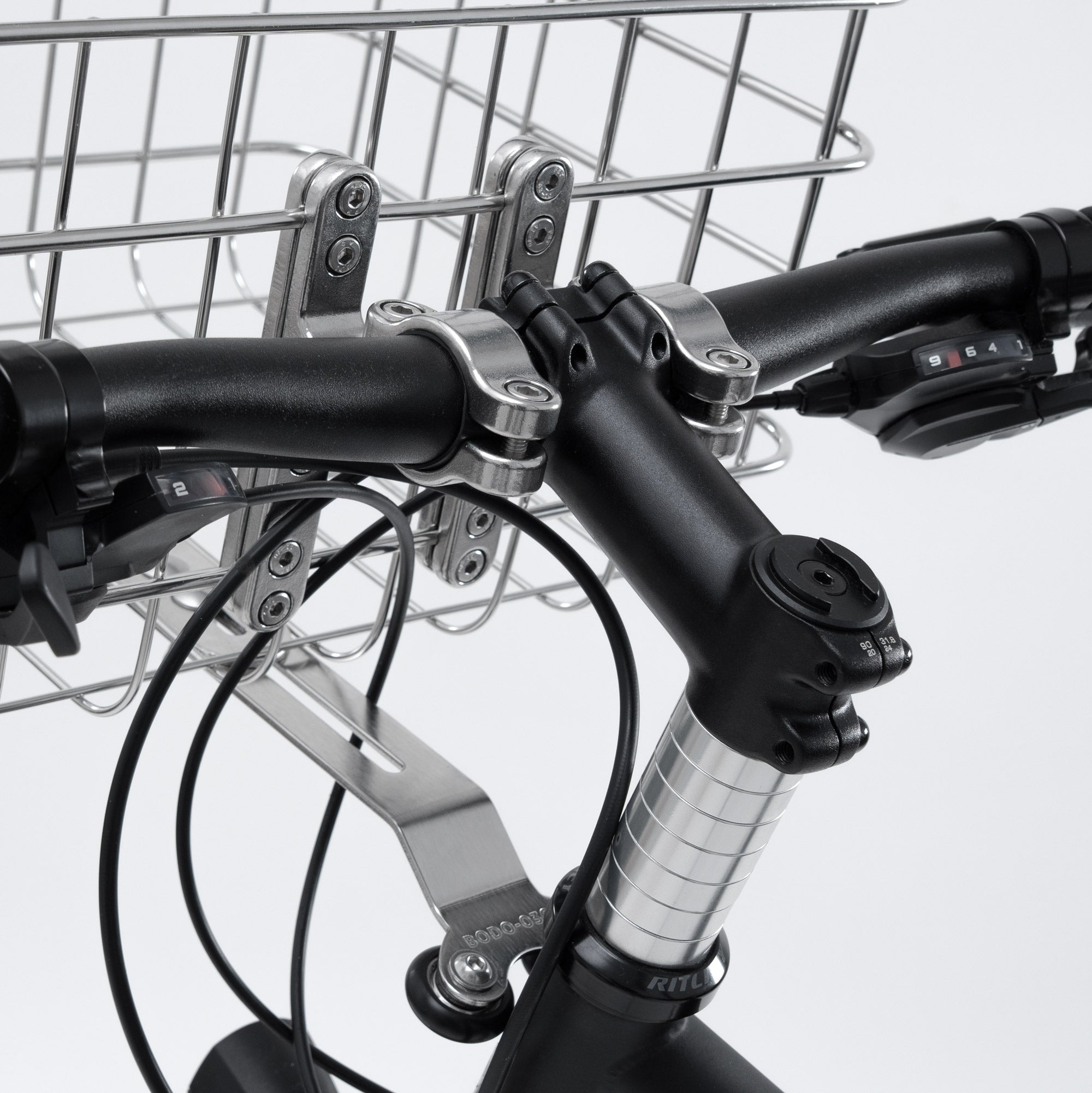
The basket should be mounted securely, provide enough space for your dog, and transfer movement as smoothly and predictably as possible.
A comfortable insert, a secure construction, and reliable weather protection help ensure that your dog experiences the space as comfortable even on longer routes.
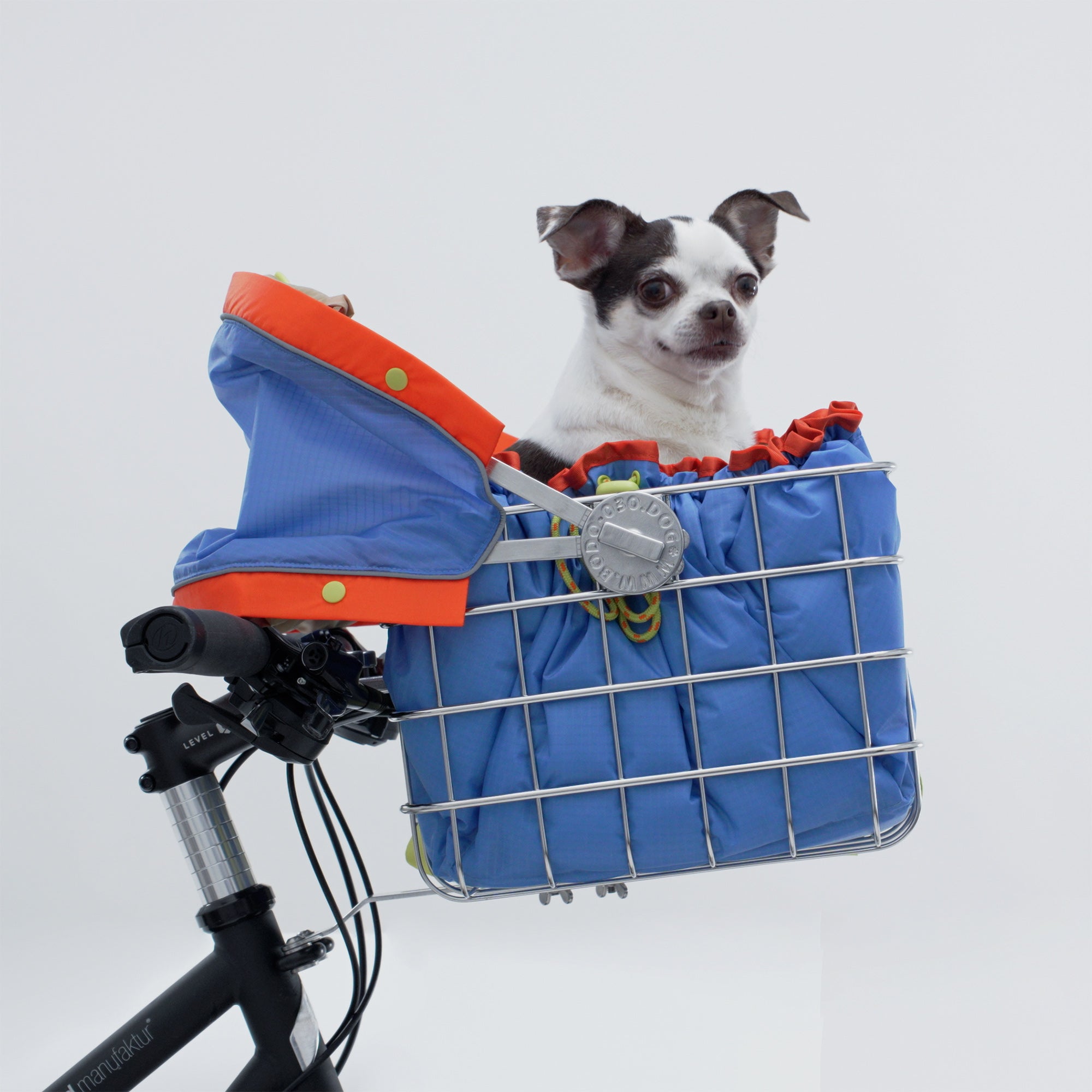
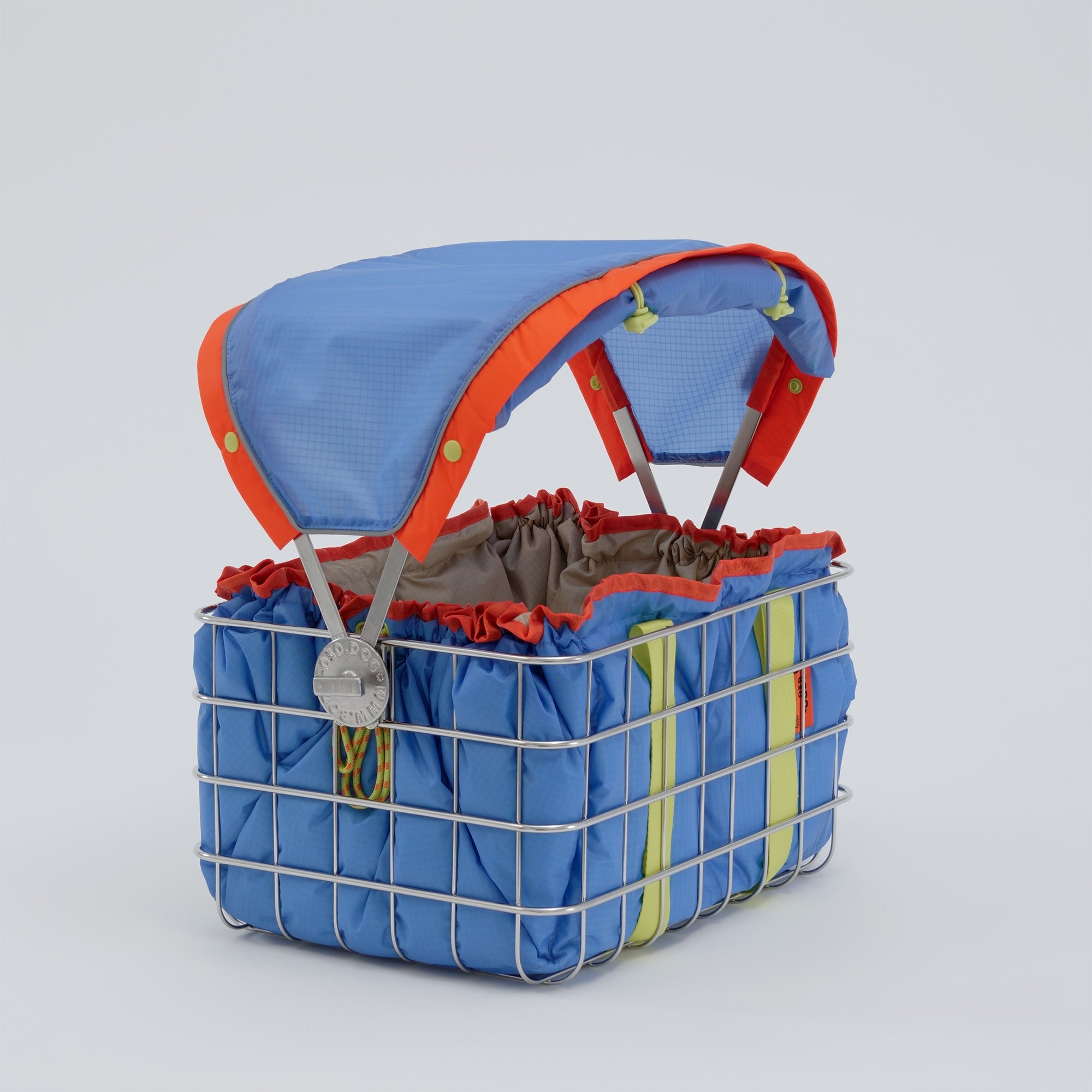
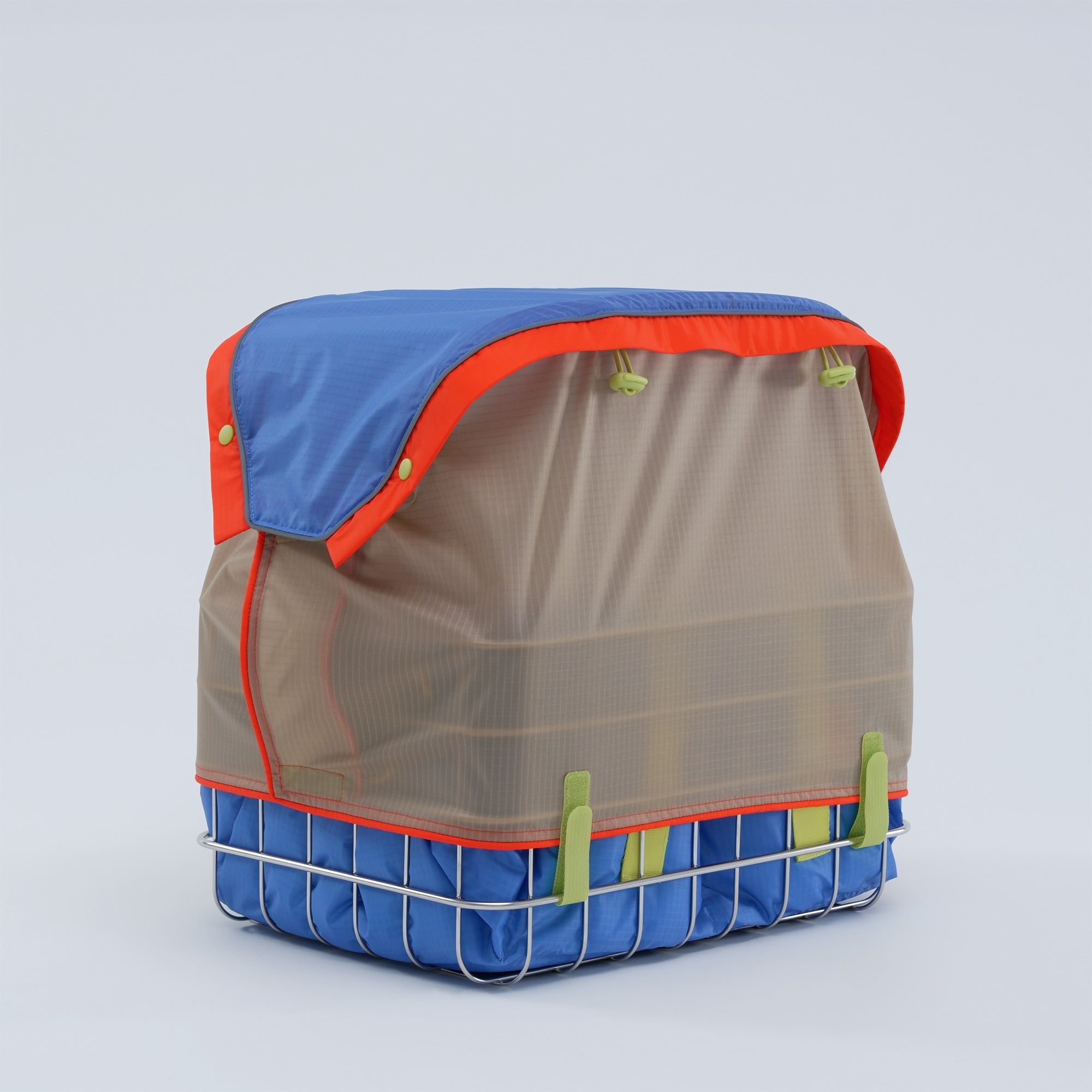
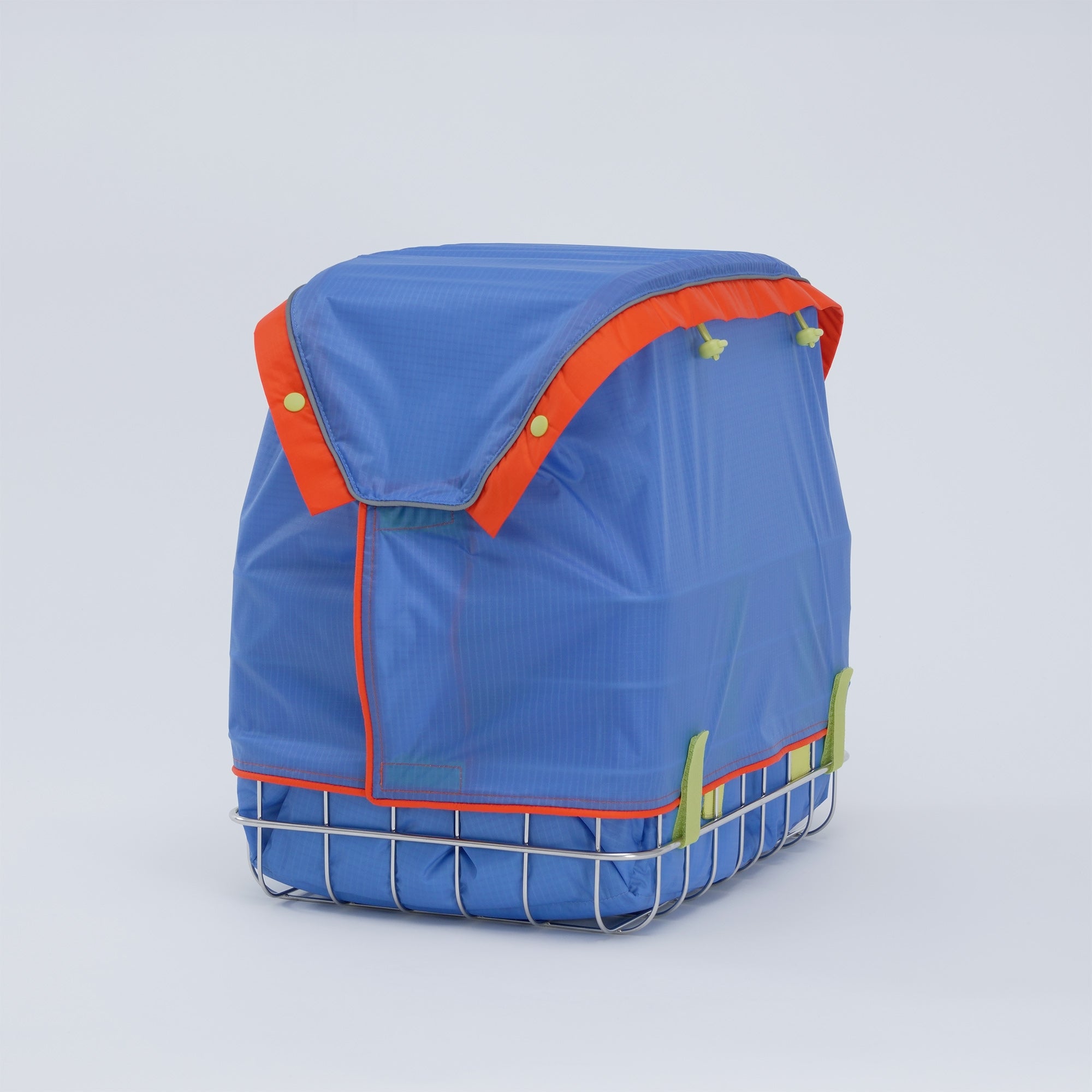
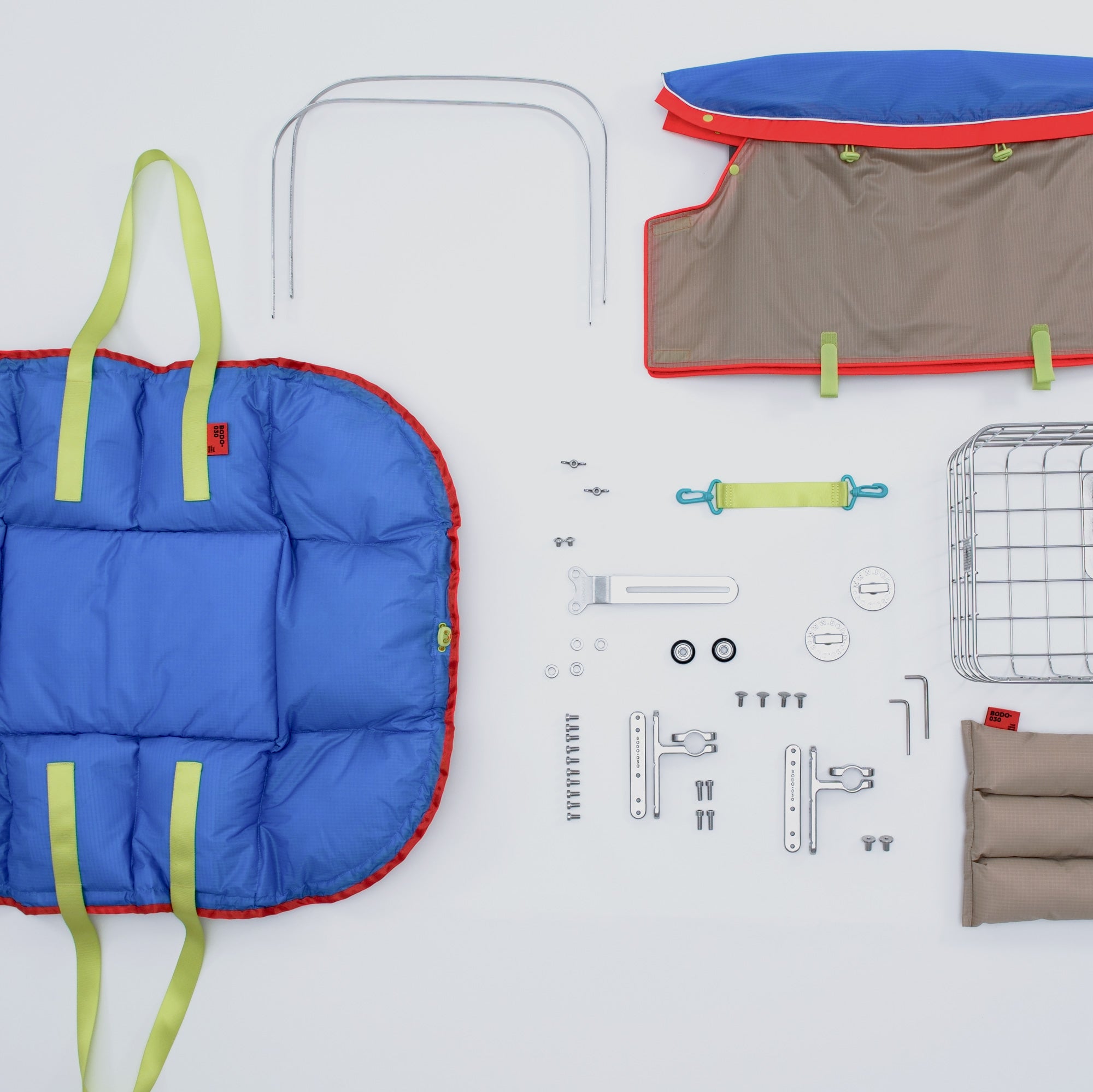
The FlyingBodo dog bike basket was developed as a complete mobility system for everyday life and longer bike tours with a dog.
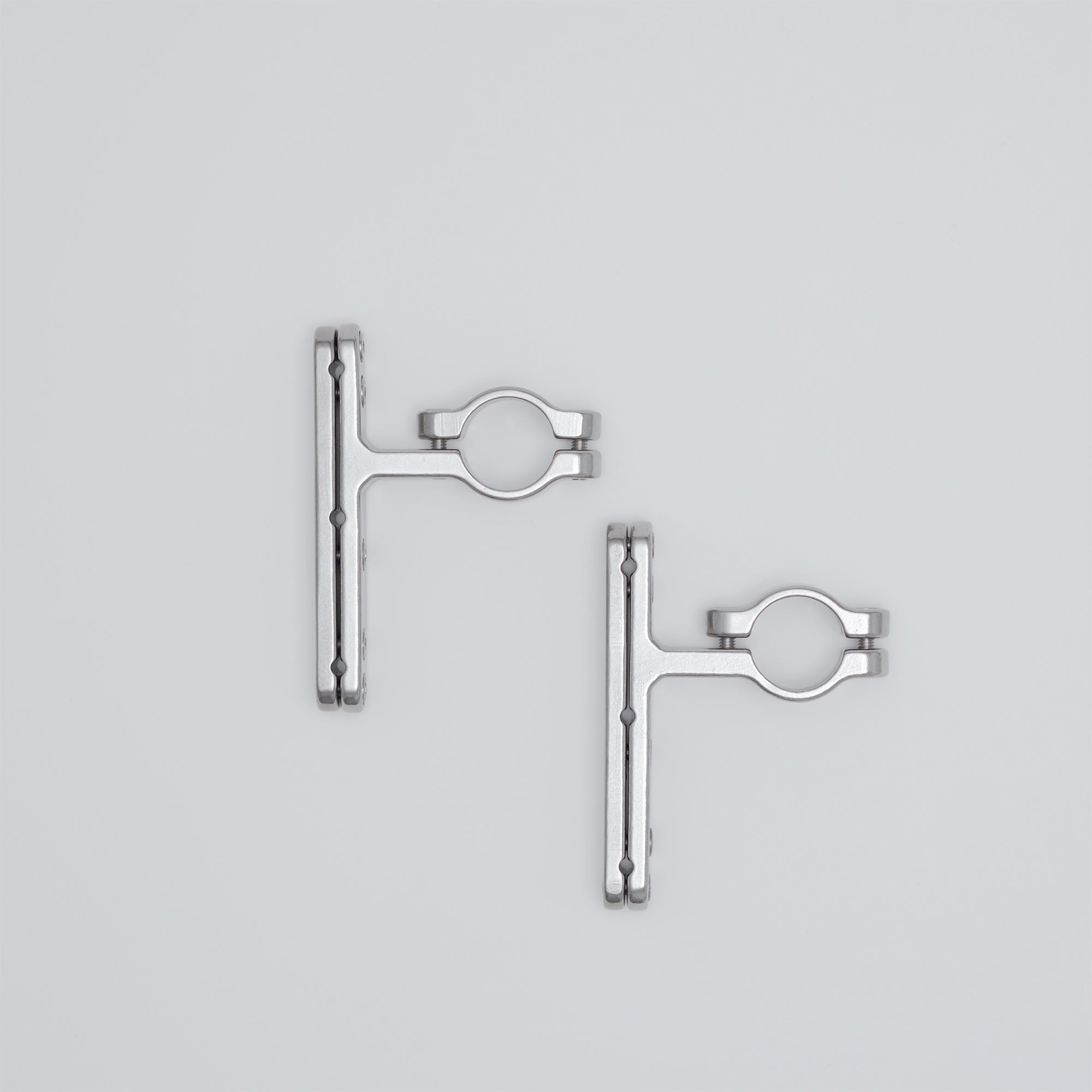
The stable mounting system with anti-tip protection, the padded interior, and the adjustable sun and rain canopy create the technical conditions for a calm and comfortable ride.
However, even with a particularly well-designed dog bike basket, familiarisation remains essential.
No product can replace the trust that develops through preparing together.
The Complete Familiarisation Process in the Video
In the video, you can watch the first steps, how to handle the basket, and how to prepare for the ride.
Getting Your Dog Used to a Dog Bike Basket – Watch the Video on YouTube
Use the video as a supplement to this guide.
Every dog learns at a different pace.
Always adapt the duration and structure to your dog’s personality and current level of training.
Conclusion: Your Dog Should Not Just Ride Along, but Feel Safe
Getting a dog used to a dog bike basket begins long before the first ride.
Your dog first learns to remain calmly on an insert.
The resting place is then moved into the basket.
Only once they reliably remain lying there for a longer period are individual movements, lifting, the canopy, and later the bicycle introduced.
Each step builds on the one before it.
The most important foundation is not speed, but reliability.
Your dog should learn:
The basket is a safe place.
Movements are predictable.
- My human controls the situation.
I remain lying down until the exercise ends.
Some dogs need only a few sessions.
Others require several weeks and many repetitions.
Both are completely acceptable.
Successful familiarisation does not end with the first successful ride.
It is complete when your dog experiences the dog bike basket as a calm, familiar, and reliable place over a longer period.

Frequently Asked Questions About Getting a Dog Used to a Dog Bike Basket
How long does it take to get a dog used to a dog bike basket?
It varies from dog to dog.
Some dogs accept the basket after only a few short training sessions.
Others need several weeks.
What matters is not the number of days, but whether your dog completes each individual step calmly and confidently.
Can I simply place my dog in the basket and start riding?
This is not recommended.
Your dog should first become familiar with the insert, the stationary basket, small movements, the canopy, and the pushed bicycle.
Only then should the first short ride begin.
What should I do if my dog constantly stands up in the basket?
The current step may still be too difficult.
Return to training on the insert or in the stationary basket.
Reward calm lying with particularly high-value treats and increase the duration gradually.
Is my dog allowed to jump into the bike basket independently?
Your dog should neither jump in nor jump out independently.
You lift them in calmly and in a controlled manner and lift them out again after the release signal.
This teaches them that you determine the beginning and end of the situation.
When should I introduce the canopy during familiarisation?
The canopy should already be part of the familiarisation process before the first ride.
Practise opening, closing, and adjusting it in a calm environment.
This allows your dog to become familiar with the sounds, movements, and different protective positions.
What should I do if there is a setback?
Reduce the difficulty and return to a familiar step.
Shorten the duration, reduce the movement, or return to training on the insert.
Remain calm and, if necessary, begin again from the start.
When is my dog ready for longer bike tours?
When they remain lying calmly in the dog bike basket for a longer period, process movement without concern, and do not constantly stand up or try to leave the basket even when small external stimuli occur.
The ride duration and the difficulty of the route should then be increased gradually.
Further Content from the BODO-030 Academy
FlyingBodo – The Stable Dog Bike Basket with Adjustable Sun Canopy
FlyingBodo Installation, Instructions, and Tips
Sun Protection in a Dog Bike Basket
Dog Bike Baskets in Summer – The 5 Biggest Mistakes in Hot Weather
Dog Bike Basket with Sun Canopy or Sun Protection – What Is the Difference?


Leave a comment
All comments are moderated before being published.
This site is protected by hCaptcha and the hCaptcha Privacy Policy and Terms of Service apply.